


Explore OKC’s Top Commercial Districts: History, Real Estate Trends & Business Potential
November 10, 2025
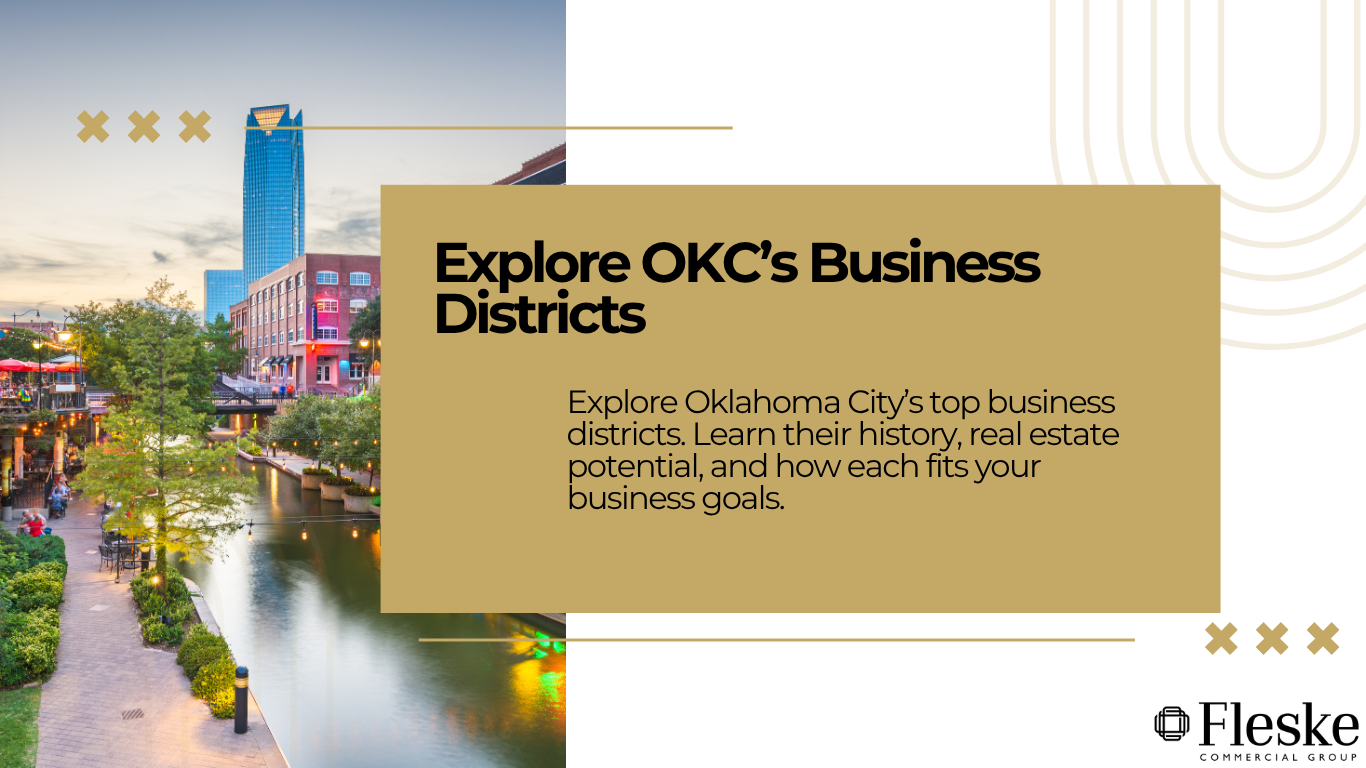
Exploring OKC’s Signature Districts: History, Real Estate & Opportunity
When businesses look for their next commercial location,district identity matters almost as much as building specs. In Oklahoma City,each neighborhood carries its own history, market dynamics, and “vibe” thatinfluences how space is used, valued, and perceived. Below is a dive into several of OKC’s most well-known districts—what they were, what they are now,and where real estate opportunity lies.
Automobile Alley
History & Evolution
Originally, Automobile Alley was the hub for car dealerships in OKC. In the 1920s, many of the city’s auto retailers clustered along Broadway north ofdowntown. Over time, as dealerships moved outward, the district declined—until a revitalization push in recent decades breathed new life into its historic storefronts.
Current Strengths & Uses
- Mixed-use: ground-floor retail, bars/restaurants, boutique shops, creative office uses, and residential lofts.
- Strong appeal for tenants who favor walkability, street activation, and the “urban feel.”
- Iconic neon signage is part of the character; the neighborhood supports a Neon Sign Grant Program to preserve and reinvest in signage heritage. VeloCity
- Events like Lights on Broadway help activate the district at night.
Real Estate Outlook
- Adaptive re-use dominates: older auto showrooms are converted to retail, boutique office, or hospitality uses.
- Because the buildings often have wide storefronts and large glass façades (a legacy of the auto showroom design), many are flexible and appealing for tenant display/retail use.
- Proximity to downtown increases value for growing small firms wanting to be near activity without paying downtown core rates.
Bricktown
History & Evolution
Bricktown began as a warehouse and railroad freight district east of downtown. Overtime, it fell into neglect. The city's MAPS initiative in the late 1990scatalyzed redevelopment: the Bricktown Canal, the ballpark, and reinvestment inpublic infrastructure helped reposition it as an entertainment hub.
Current Strengths & Uses
- Highly active entertainment district: bars, restaurants, nightlife, lodging, sports, and canal-side attractions.
- Office and residential infill continues in proximity to attractions.
- The canal and public amenities drive foot traffic.
- Annual Bricktown Art Festival provides cultural draw.
- Tourism is a key driver; many visitors pass through Bricktown en route to or from downtown.
Real Estate Outlook
- Retail and restaurant uses command premium rents given visibility and foot traffic.
- Office tenants seeking experiential or high-visibility locations could be a growth segment.
- Land scarcity in core Bricktown means redevelopment of smaller parcels or repurposing is common.
- Events and activations help individual tenants benefit from collective district marketing.
Uptown23rd
History & Evolution
Uptown is north of midtown and features historic neighborhoods crossed by majorstreets like NW 23rd, Classen Blvd, and Western Avenue Some of its character istied to Route 66-era architecture and small storefronts in older neighborhoods. Uptown is our home and one of ourfavorite districts!
Current Strengths & Uses
- Retail corridor presence, especially along Walker and 23rd Street.
- Small footprint storefronts (local, niche) coexist with creative or boutique office.
- The urban-suburban balance appeals to tenants wanting walkable amenities but not full downtown costs.
Real Estate Outlook
- Opportunities for “main street–style” retail/office live-work conversions.
- Redevelopment potential with infill growth or updates to existing buildings.
- Tenants who serve nearby neighborhoods—e.g. fitness, boutique retail, coffee, health services—are good candidates.
Plaza District
History & Evolution
The Plaza District developed along NW 16th Street in the early 20th century,anchored by its position on the trolley line and later bolstered by the PlazaTheatre in the 1930s Over time, it saw periods of decline and resurgence tied to arts and local entrepreneurship.
Current Strengths & Uses
- Known for its local boutiques, galleries, vintage shops, and independent restaurants.
- The Plaza Theatre hosts performances and is a cultural anchor.
- LIVE on the Plaza (a monthly art walk/event) helps energize the district.
- Murals and street art amplify the district’s creative branding.
- A favorite for creative services (design, studios), small retail, and experiential pop-ups.
Real Estate Outlook
- Small-bay storefronts are ideal; these can be tight fits but provide excellent visibility and branding for boutiques.
- Creative office or flex space often blends with retail.
- Because the district is beloved by locals, tenants aligned with community identity tend to perform well.
FilmRow / West Village
History & Evolution
Film Row (also called the Film Exchange Historic District) occupies parts ofwhat’s now considered the West Village area. In the 1930s–1950s, it was home tostudios like MGM, Paramount, Fox, and Warner, which distributed films toregional theaters. Many buildings included fireproof vaults for nitrate filmstorage. West Village District Over time, the film exchange businessdiminished, and the district fell into disuse—until renewed interest inhistoric rehab and creative reuse.
Current Strengths & Uses
- Design, creative firms, small boutiques, specialty retail, cafés, galleries.
- Historic architectural elements (Art Deco, low-scale commercial) give it a distinct character.
- Streetscaping and preservation efforts emphasize its film heritage.
- Close proximity to downtown gives it appeal for tenants wanting walkable access to the core with a less intense environment.
Real Estate Outlook
- Adaptive reuse of smaller historic buildings is key.
- Creative users, small agencies, architects, design studios are strong candidates.
- Ground-floor retailers benefit from curiosity, heritage branding, and foot traffic spillover.
- Because supply is limited, premium may apply for well-preserved, character-rich spaces.
Why District Choice Matters in CRE
Brand alignment & customer perception
Your business looks different in Film Row vs. Bricktown vs. Plaza. Choosing theright district reinforces your brand story.
Foot traffic & traffic patterns
Entertainment zones like Bricktown or Automobile Alley benefit from evening andweekend traffic. Office districts rely more heavily on weekday daytime flows.
Rental rate expectations & demand
District premiums vary. Downtown or marquee districts will command higherrents; emerging or fringe areas may offer better value if your audience aligns.
Reuse potential & building typology
Historic districts tend to have smaller bays, legacy storefronts, and adaptive floors — useful for boutique, creative, or experiential tenants.
Community & event activation
Because districts often host festivals, art walks, or public events, tenants indirectly benefit from shared marketing and foot-traffic boosts.
Zoning & development incentives
Some districts have overlays, tax incentives, or design guidelines. Knowing which district you’re in can unlock or restrict certain uses.
